American Institute of Physics Grant
I’ll be attending the American Astronomical Society’s 248th meeting in Pasadena, CA, June 14-18, thanks to the first-ever grant award for Harlow Shapley Project.
The American Institute of Physics (AIP) awarded a Grant-in-Aid for me to be in Pasadena that week to attend the meeting and do research at the Huntington Library and Caltech Archives. I’ll be looking for perceptions of the young Harlow Shapley in 1914-21 by others at Mount Wilson Observatory.
Hubble and Shapley famously differed over whether there are “island universes” - galaxies beyond our own. They also disliked one another but depended on each other’s work. I spoke on “Hubble v Shapley” at the American Astronomical Society’s 245th meeting in January 2025. Now, the AIP- funded research may give me more of the Californians’ perspective. Thank you, AIP!
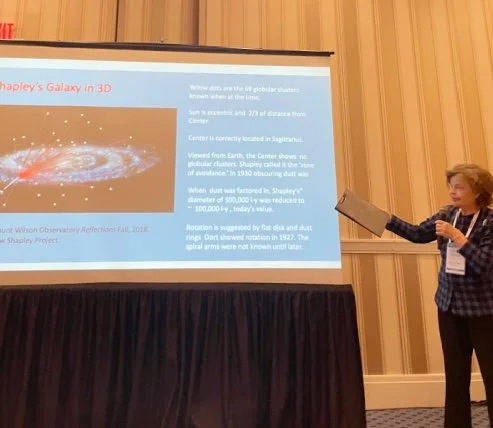
Deborah speaking on “Shapley v Hubble” at AAS245, National Harbor, Md. Photo. Liz Landau
Zenodo repository to carry Shapley Project content

Zenodo.org is an enormous worldwide database of scientific publications. It originated as a European initiative and is maintained by CERN. It’s data has expanded across users in many languages and fields. By 2021 it held more than 1 Petabyte of data and had 15 million users per year.
Blog posts and other content on the Harlow Shapley hub website can now be uploaded to the Zenodo system! Teaching me to do this is Jennifer Lynn Bartlett. Jennifer is an authority on scientific indexing, among her many roles.
I can step into this vast archive with my own key - my ORCiD number! It is 0009-0008-7946-7311. Now I can upload any published post along with links to related content in Zenodo’s data pile.
The first upload will be our updated Bibliography of Harlow Shapley’s published writing. It is the fullest list of Shapley’s publications anywhere. It is the diligent work of Shapley Project Associate Thomas J. Bogdan. Thank you, Tom!
Listings in Zenodo will advance the Harlow Shapley Project’s goal “to insert Shapley’s achievements … in scientific and historical narratives.”
New post: NASA Moon Triumph & Willis Shapley
Following on the Artemis II mission, the Trump administration announced plans to have astronauts land on the moon in 2028. This would be followed by human habitation and resource use - even as the administration cuts NASA space science to the bone.
In a new post I recap the role of my father Willis H. Shapley. He was an expert on military and space budgets at the Bureau of the Budget, 1942-1965. He was “No. 3,” NASA’s third top administrator during the Apollo program, 1965-1975. He helped to keep space science funded despite competition from high-profile manned space programs. He was recognized. For example, he received NASA Distinguished Service Medals in 1969 and in 1988.
Lost History: Harlow Shapley from 1953 “We are not alone”
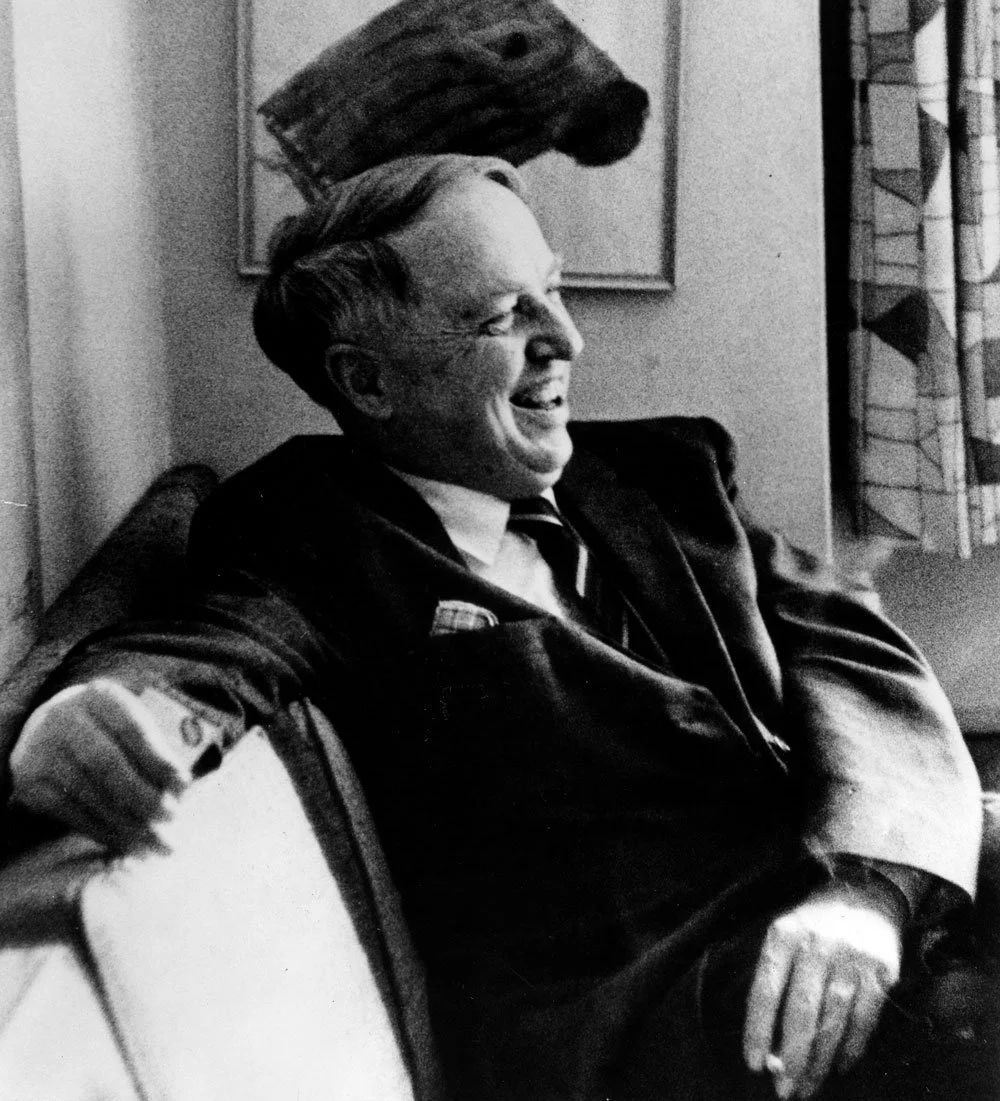
Harlow Shapley in March 1960, during filming of Of Stars and Men. AIP/ESVA
The search for habitable worlds is the subject of many recent books and TV shows. But Harlow Shapley’s role in validating the possibility of life on other planets is hardly (if ever) mentioned! Yet it is a fact that, starting in 1953 and through the late 1960s Shapley, the world’s greatest living astronomer, promoted the view that the universe is abundant with life. “We are not alone.”
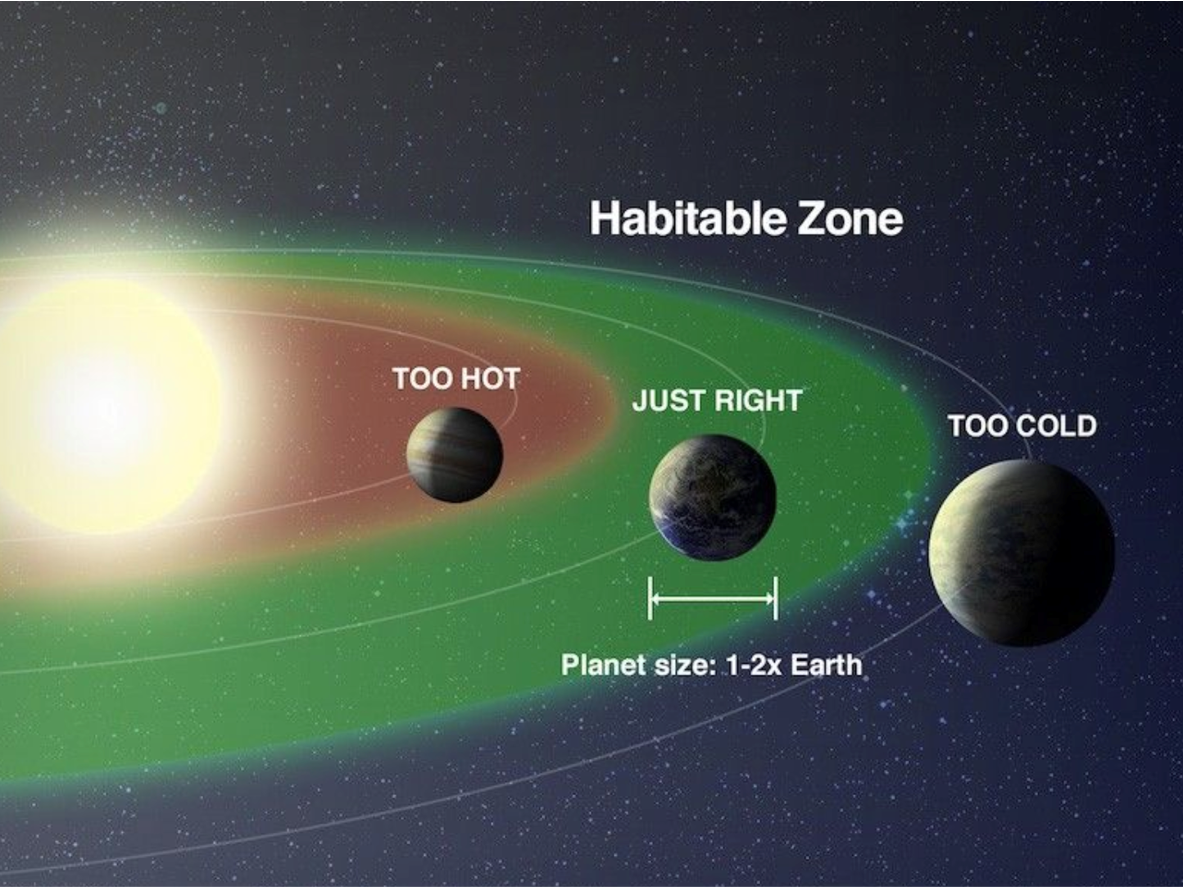
The Liquid Water Belt required for a planet to host life is also the Habitable Zone. Shapley published this requirement in 1953. NASA Graphic
In 1953 Shapley concluded that millions of other stars could be “life theaters.” He based this on findings of scientists in different fields, such our Sun’s radience, the Earth’s particular orbit, earth’s early atmosphere and oceans In a pair of 1953 publications Shapley listed the “Six Conditions for Life” on a planet orbiting a star. The first condition is “the liquid water belt.”
‘1 - Water…must be available in liquid form…The basic requirement, therefore, is that the living planet must be at a proper distance from its star – in the liquid water belt - not as close to the sun as Mercury and not so distant as Jupiter.”
Then he calculated the number of stars in the known universe at one hundred billion (10 20 ) By “ruthless” elimination - such as ruling out double stars- he computed that one hundred million (10 8) stars have planets that could host “some form of advanced life.” “The life phenomenon is widespread and of cosmic significance.”
Stay tuned for the rest to be told in my post. Frank Drake credited Shapley in his 1960 computation of the odds of advanced civilizations in our galaxy.
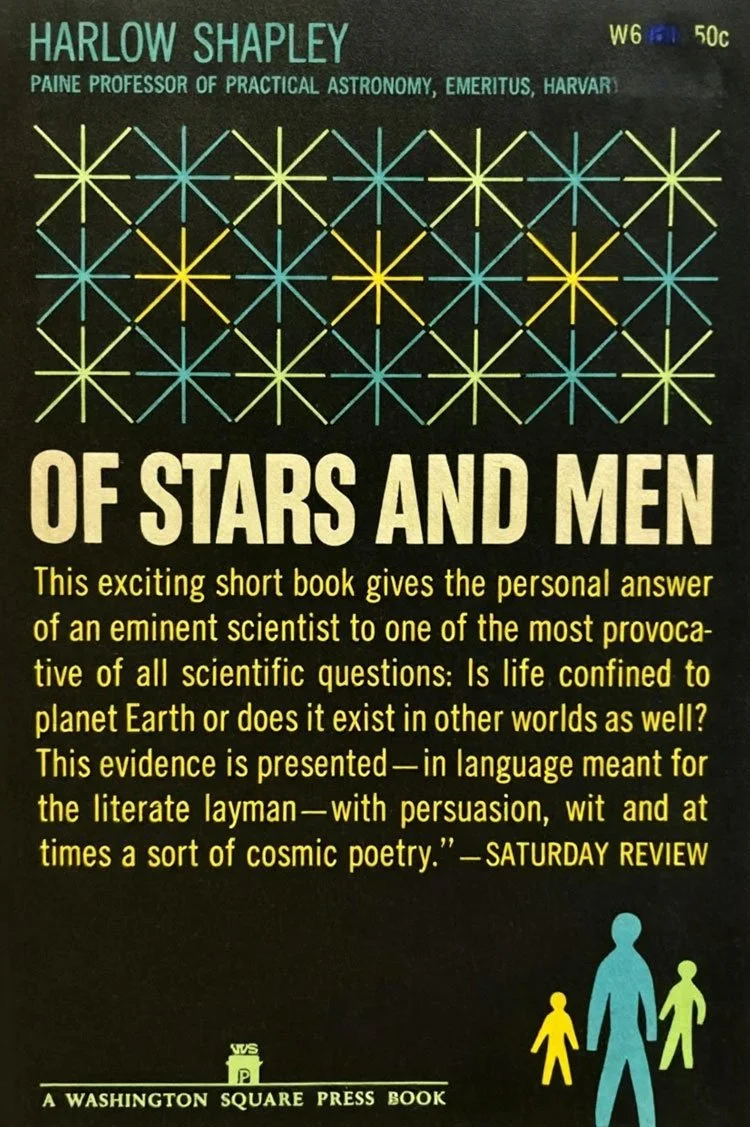
And Shapley, having retired from Harvard, took to the road to promote his vision of life in an expanding universe and our place in it.
Shapley’s 1958 book Of Stars and Men and the enchanting movie of it influenced public opinion in favor of science, astronomy and the search.
Screen from Hubley film Of Stars and Men which Shapley narrates.
Nota bene:
Collections recently used: American Academy of Arts & Sciences, Schlesinger Library, Harvard University Archives, American Institute of Physics, Newspapers.com.
Team: We welcome Susanne Oltmanns (Connect and Flourish) who took over maintaining the site. Huge thanks go to Sophia Ojha, the programmer since 2019, who retired. Special thanks go to Thomas J. Bogdan for his new edition of the Bibliography, his mapping of Shapley-Betz-Stowell ancestors, locating hard-to-find publications, and making a chronology of Shapley’s lectures.
What I’m reading:
Portrait of a Binary: The Lives of Cecilia Payne and Sergei Gaposchkin by Sylvia L. Boyd (Pensobscot Press, 2014). A fresh, well-sourced account of this famous couple and of the Harvard College Observatory in the Shapley and Menzel eras.
Of Stars and Men: The Human Response to An Expanding Universe, by Harlow Shapley (Beacon Press, 1958) Still a classic at 157 pages. Amazon scores 4.4 of 5. One reader commented: “It really awakes the curiosity and makes to think what is a man in the immensity of time and space.”

Harlow Shapley Project
We welcome your questions and comments on our About & Contact page.