Trip Report by Deborah Shapley
On my trip to Pasadena CA I found important aspects of the wide legacy of Harlow Shapley (1885-1972). I found that a program he founded in 1958 for astronomers to teach at small campuses the country is going strong. Also I helped to find some actual glass plates Shapley made on the 60-inch telescope atop Mount Wilson telescope back in 1915.
In this “trip report” I share three highlights of Harlow Shapley’s legacy I learned on this week-long visit. I include my own comments about why they are important to understanding the man and his work. I also write to thank the American Institute of Physics (AIP) for the Grant-in-Aid award that made the trip possible.
Stop 1: AAS Shapley Visiting Lectures: Vision
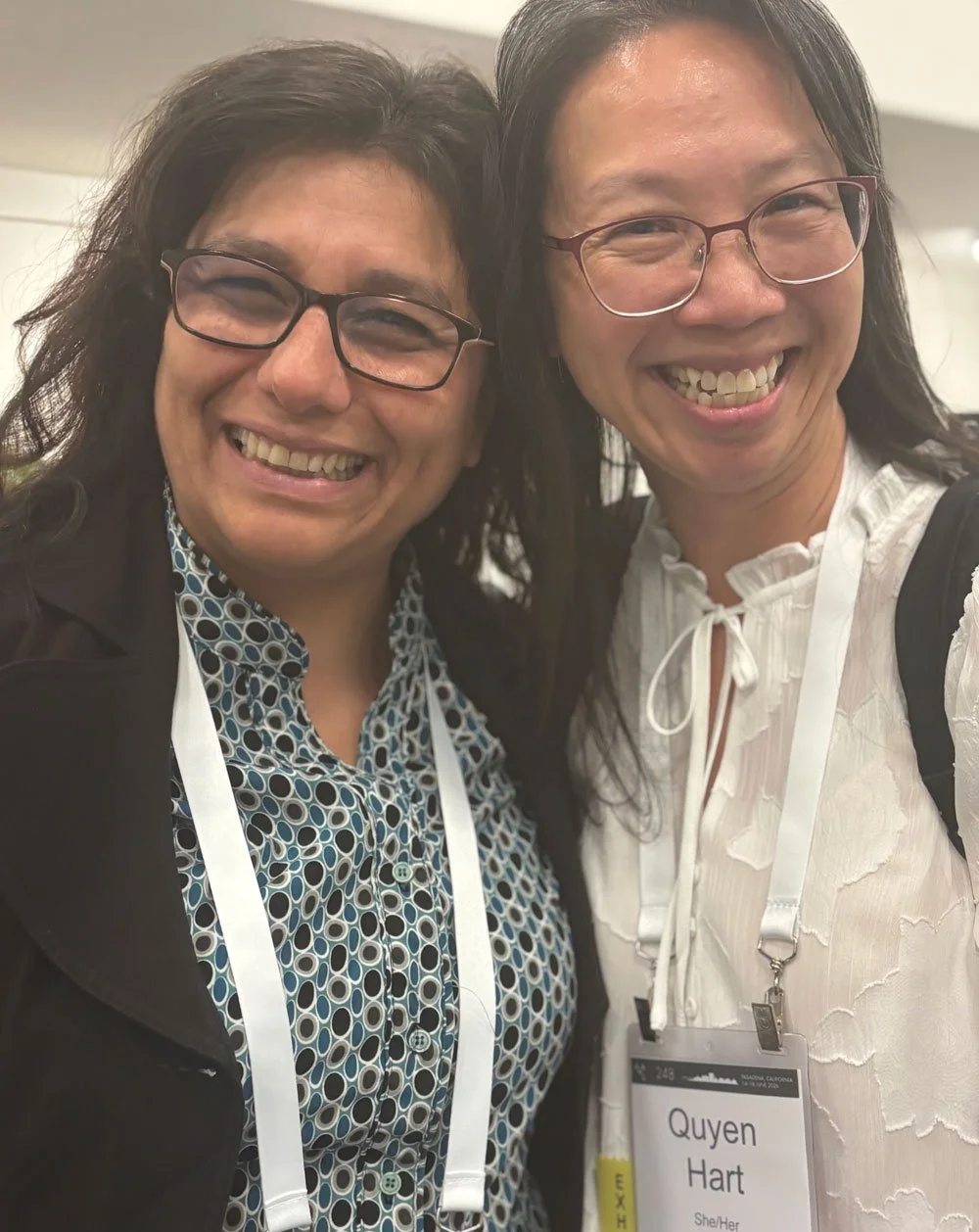
Arias-Young and Hart at AAS Shapley Lectures reception.
The grant enabled me to go to the American Astronomical Society’s 248 meeting held in the Pasadena Civic Center. There it was inspiring to meet dozens of astronomers and teachers involved in the Harlow Shapley Visiting Lectures Program. The program’s goal is to “expand access to astronomy, by bringing distinguished astronomers’ … to inspire people to bring science into their lives.”
The SVL sponsors ”Lecturers” who are astronomers and good communicators. Each is paired with a “Host” from a local college, who arranges a two-to-three-day program. The guest astronomer offers “a highly accessible public lecture” and engages with schools and community groups. The Lecturer meets college students and faculty to teach and inspire their interest.
The “SVLs” were a lively group. One Lecturer I met was Quyen Hart, project scientist with the Space Telescope Science Institute. She had spent four days in Wyoming hosted by Casper College, where her Host was physics professor Drew Young. Hart gave a public lecture on the JWST, engaged with college students and faculty, spoke at the local planetarium, and met the college president and trustees. Quyen Hart’s visits. In the 2026-2027 academic year, 21 Shapley Lecturers will visit destinations in 17 states.
AAS Harlow Shapley Lecturer visits in 2024-2025
Shapley was President of AAS from 1943-1946. He co-founded its Visiting Professors program in 1958 and was one of the first Lecturers that year. The program was renamed for him in 1974. It has continued ever since. It is managed now by Tom Rice, Director of Education Programs at AAS and Donna Richardson of the SETI Institute.
Shapley lectured frequently throughout his career. When his Harvard tenure ended in 1956 he set out off lecturing, boosted by four popular books. 1/ He often chose colleges In the Midwest and South and women’s colleges. Local papers covered his visits; they often ran a photo of a star cluster Shapley would show in the lecture. The host college head got credit.
He gave 17 lectures to lay audiences in 1956, 48 in 1957, and 54 in 1958. These are typical, as shown by the Shapley Project table of his public appearances from 1918 to 1969. The table does not count presentations to scientific groups like AAS.
Access to Science – His Vision
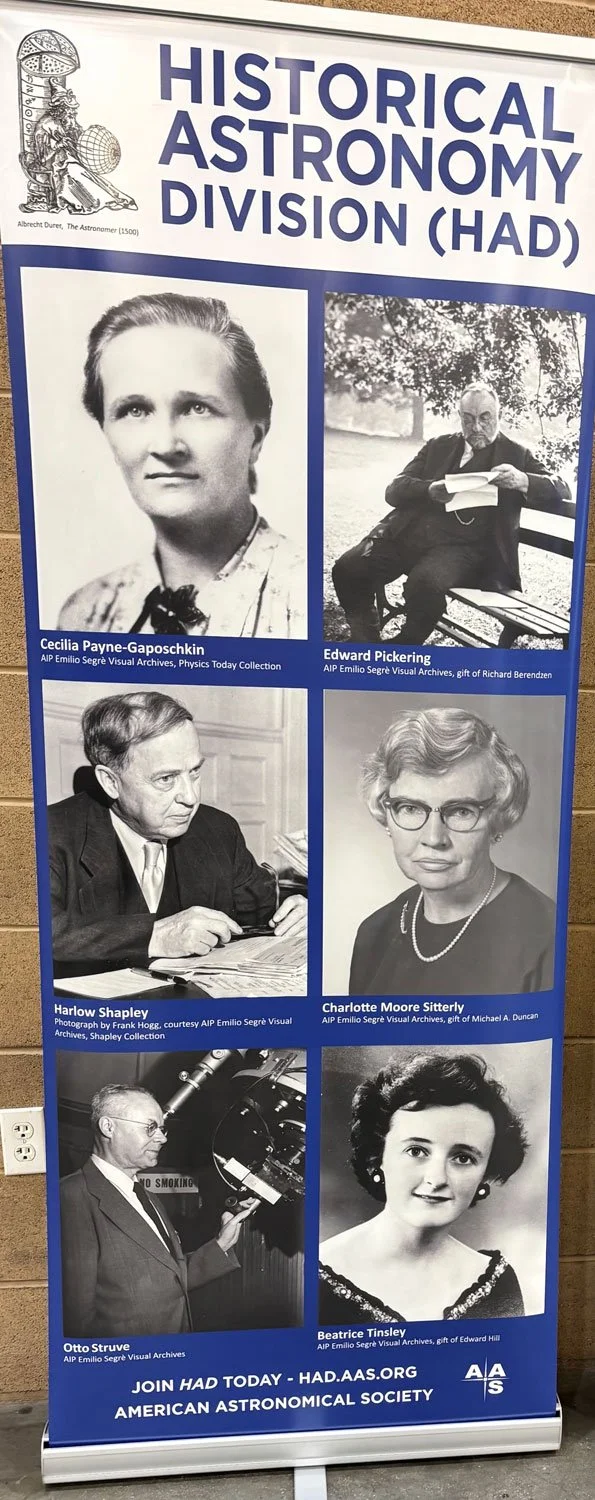
Poster for the Historical Astronomy Division (HAD) of American Astronomical Associaton.
Shapley was raised on his father’s wheat farm in southwest Missouri. He was taught by his sister in a one-room schoolhouse. He had further formal learning in Carthage while working stints as a reporter to pay for school. He was largely self-taught. He entered the University of Missouri in 1906. There he found a mentor in astronomy professor Frederick H. Seares. Seares started the 21-year-old Shapley in astronomy. He gave Shapley a regular job with his own desk. The rest is history. By 1915 Shapley was a Mount Wilson Observatory staff astronomer, beginning to change our view of the universe. All his life he kept his Ozark accent and respect for what people of modest means can achieve in science.
His lectures became one hallmark of his career.
In the April 26 1920 “Great Debate” with senior Yerkes astronomer Heber D. Curtis, he performed poorly, according to accounts. In October 1923 the new director of HCO addressed the Association of Amateur Variable Star Observers (AAVSO). A listener reported, “his diction is delightful, his language simple, his facts clearly expressed and easily understood.” His “admixture of humor” adds “sparkle.”
Shapley relentlessly promoted scientific knowledge through the press and education. No surprise that during World War Two, as science became a national endeavor, his postwar vision called for its further spread: all people should have the chance to learn about and explore science.
I’ll close with a quote from his essay “A Design for Fighting.” It ran in The Atlantic in August 1945. No surprise that it is based on a lecture! Shapley uses wartime language to declare that our real enemy is the “Tyranny of the Unknown.” We must quit leaving the explorations to “long-haired professors.”
“It is time we stopped treating the acquisition of new knowledge as the luxury of a special class, or as the precursor to profit-making new gadgets or nostrums .….
“The contest with the Tyranny of the Unknown” is a job for the people of the United States of America if we are going to keep up the competition with other countries and if they are planning to participate in either the practical or the idealized progress of mankind.””
Stop 2: Shapley’s Telescope and Glass Plates
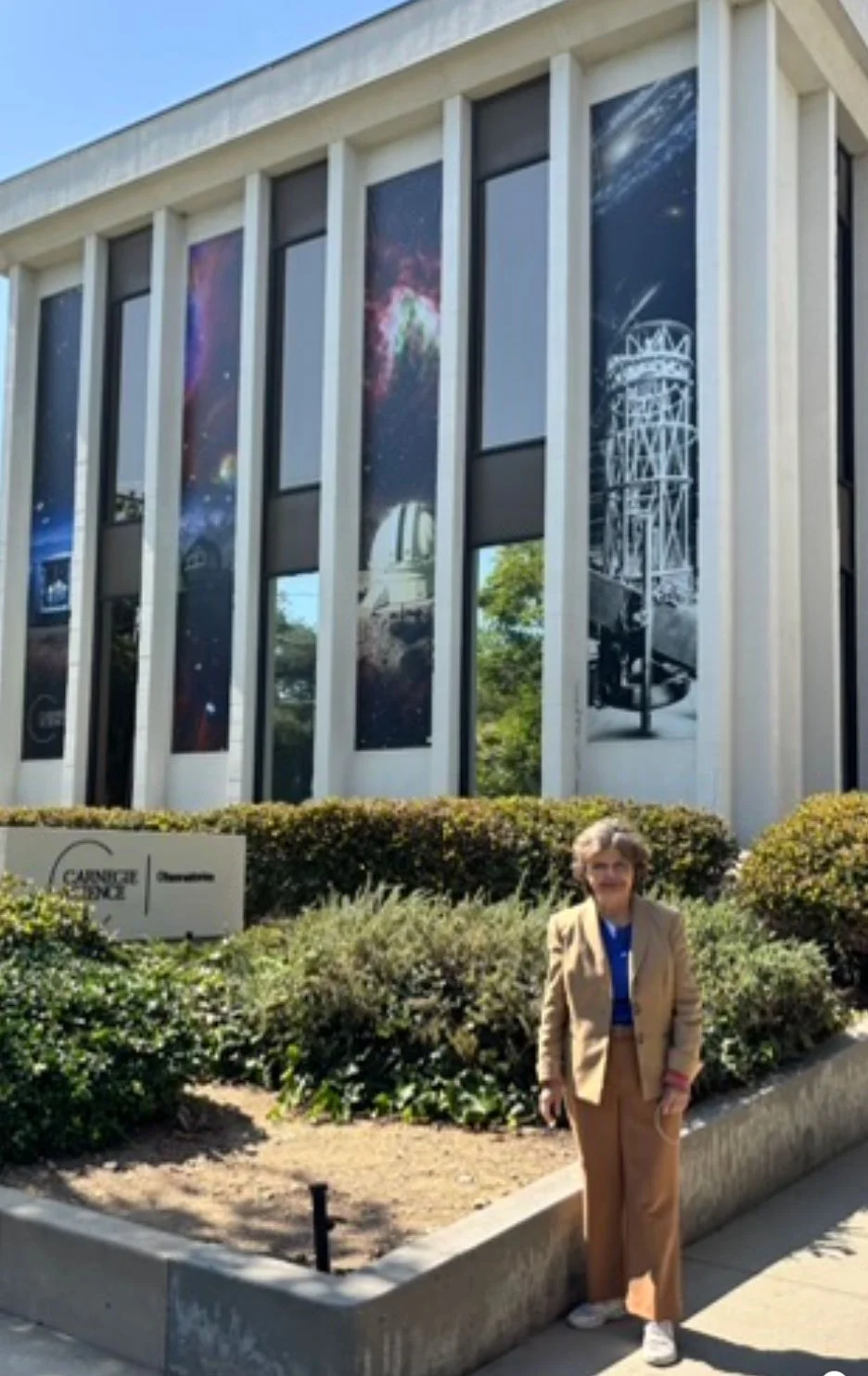
Deborah at the Carnegie Observatories headquarters at 813 Santa Barbara Street in Pasadena. It adjoins the historic offices where great figures in astronomy worked.
Shapley discovered the huge size of our galaxy and its dense center off in the constellation Sagittarius. He located our Sun and planets out near the edge of the galactic disk – not at the center as had been believed since Copernicus.
He brought about this revolution with the 60-inch telescope on the observatory campus on Mount Wilson overlooking Pasadena. This telescope was conceived and built by George Ellery Hale, the visionary solar astronomer who already had installed two solar telescopes there. When Hale’s big new optical telescope opened in 1908 it was a world-beater. It has a 60-inch mirror set in 22 ½ tons of moving metal parts. It still works. 2/
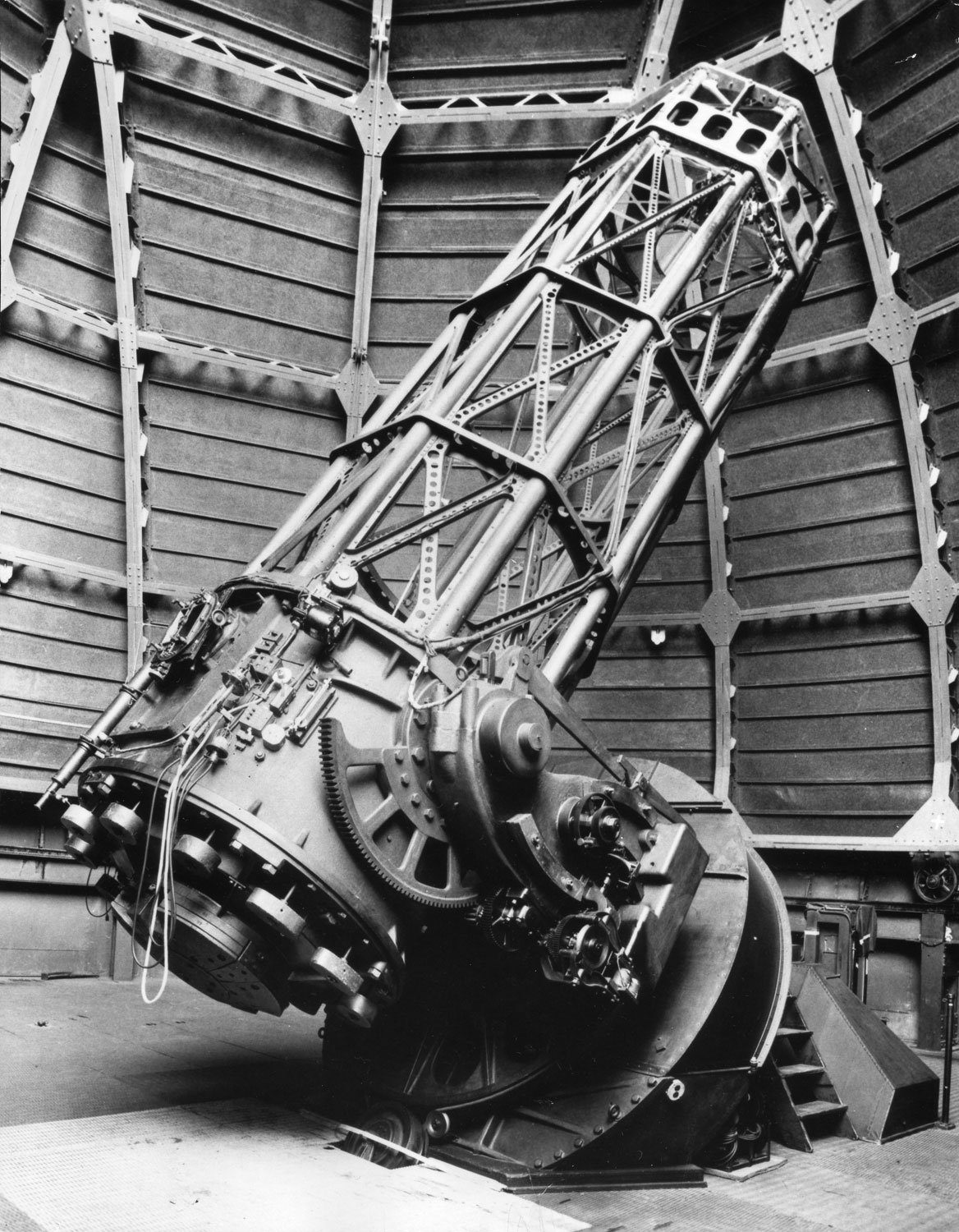
The 60-inch telescope at Mount Wilson Observatory. Photo Huntington Library nbla_303561.
The astronomer chooses a target “object” – a star or cluster. Then his assistant adjusts the shutters and the telescope’s pitch so light from the target shoots through the lens and mirror system to imprint a small glass plate on a camera inside.
Starlight can take time to print on the special glass. So the astronomer must peer at the developing image on the plate while his assistant wields the giant machinery. They must keep everything in position for hours, sometimes through the night, while the earth turns below the whole assemblage.
Then, in the laboratory, the data from specks on the plate is “reduced” and written down. The image on the glass may be printed as a photograph. The original plate Is slipped in its marked-up paper sleeve and filed in the observatory vault with other plates of the same object. The specks on the glass gave the object’s brightness and size. A corresponding spectral strip taken during the same session yields its color and temperature.
Starting in 1914 Shapley used this telescope to devise a series of steps to locate “objects” farther away than anyone had tried before. His ladder was based on Henrietta Swan Leavitt’s 1912 period-luminosity law for finding the distance to nearby Cepheid variable stars. In 1913 Ejnar Hertzsprung applied Leavitt’s law to get distances to nearby Cepheids.
When Leavitt worked on Cepheids, astronomers assumed they were binary stars whose passing around each other caused their regular variation in light. Shapley’s August 1914 paper “On the nature and cause of Cepheid variation” argued they could not physically be a pair of stars. Therefore their light pulsation must be due to radiative change. Thus Cepheid spectral changes could be used to probe a star’s interior.3/ This conclusion opened the door to the use of Cepheids in astrophysics. Sir Arthur Eddington later said this paper opened the way for his study of stellar structure.
Leavitt and Hertzsprung’s work would be the base of Shapley’s ladder.
Globular clusters were Shapley’s chosen “objects” to locate and study at Mount Wilson. 4/ These are bright, round packages of light with few detectable stars. First he plotted distance and positions of globular clusters where big, bright Cepheids could be seen. Then he peered at clusters with Cepheids and fast-flashing cluster variables known as RR Lyrae stars. (Pro. LEE-ray)
With the distances to clusters with Cepheids and RR Lyrae, he could find the distance to clusters where only RR Lyrae could be seen: his second “rung.” He fashioned a third “rung” starting with clusters with RR Lyrae and bright blue stars visible; he used their distance to get distance to globular clusters farther out showing only blue stars. Finally, he fashioned a fourth “rung” to the most distant globular clusters by taking the average brightness of those with bright blue stars, Knowing their distances enabled him to compute distance to the globular clusters where no individual stars could be seen, by using average brightness only.
Thus he plotted the locations all 69 globular clusters then detectable across the sky. (Jeff: Which is farthest Need NGC # and distance Papers VI, VII. Also which tablse is the right summation of the 69? A note will say distances got correctde by him and others later.}
Their arrangement showed the galaxy’s mass was not around the Sun; the globular clusters formed “a skeleton” around a central region far from the Sun and planets.
He rolled out his huge measurement project in a series of “great papers.” He numbered them from I in 1915 through XIX in 1921 (CIW editions). He compiled his grand results in Papers VI and VII of 1918, so 1918 is given as the year of his discovery. Each paper has tables of data about clusters and individual stars. They tally fresh observations by him and by other astronomers at MWO and a bigger pile of data about each cluster and star of over hundreds of observations of it in the scientific literature.
Shapley’s papers are classics. After all, they revolutionized how we view the cosmos. But a search has not been made for the glass plates he used. His work is supported by data and arguments in the papers and photographs made from plates. But the plates have historic value of themselves.
Diving for glass treasure
Jeffrey A. Rich in the historic Library of the Mount Wilson Observatory building, with laptop and lightbox.
In the famous library of the Mount Wilson Observatory offices on Santa Barbara Street, I met up with Jeffrey A. Rich a PhD astronomer who teaches about Shapley’s work. Much twentieth century history has taken place in this room; it could be simply a shrine. Instead youngsters come there for the STEM classes that Dr. Rich teaches for Carnegie Science, which has the large modern building next door.
The floor below has the unique vault that holds more than 200,000 glass plate negatives recorded between 1892 and 1994, the second largest collection of its kind in the world.
Plates taken by Shapley in his seven years in Pasadena should be in the vault library below. But he could have shipped them to Harvard when he left in April 1921.
We chose Paper II; “Thirteen hundred stars in the Hercules Cluster (Messier 13)” published in CIW etc 1915. It’s 89 pages have 27 dense tables and 12 figures. 5/
Shapley opens by noting the Hercules cluster has been studied often since its discovery by X in 17__[NGC 1774]. “Only two variable stars had been recorded among the thousand brightest objects.” He says his paper’s results rely on “observations and measurements by the writer.” And “a great deal of assistance has been given by Mrs. Shapley.” 6/
He writes 5 new variable stars have been found, bringing the total number of variable stars in M 13 to 7. The two known ones are almost certainly Cepheids and the new ones have Cepheid type variation. He also describes bright “cluster variables” very short periods He writes 5 new variable stars have been found, bringing the total of variable stars in M 13 to 7. The two known ones are almost certainly Cepheids and the 5 new ones have Cepheid-type variation. He also describes bright “cluster variables” with very short periods. In 1919 in Paper VIII he followed up about these fast-flashers, which came to be called RR Lyrae.
He tallies and compares past observations of M 13’s taken on telescopes in Peru (for Harvard) and European observatories.
Finally he computes the Hercules cluster to be at “a provisional distance of a hundred thousand light years. There seems reasonably clear evidence that this and similar globular clusters are very distant systems.” 8/
Shapley submitted this paper in August 1915. Apparently he did not know where his hunt for the other clusters was going. Commenters have noted his boldness. He now published a distance to Hercules that was ten times* the width of the entire galactic disk thought to be of 10,000 light years wide and to be the universe! 7/
Our Investigation
First Rich opened Paper I to the summary Table I. The left column has plate numbers for each observation. The latest pair were taken on March 15, 1915. (CIW page 231)
Rich and I started with Table I that lists his key observations from August 23, 1914 through March 15, 1915. We chose one of two optical plates Shapley took on his last night – evidently it was important! (The Table shows two spectral plates he took at the same time. We left these for another day.)
Finding state-of-the-art data from 1915
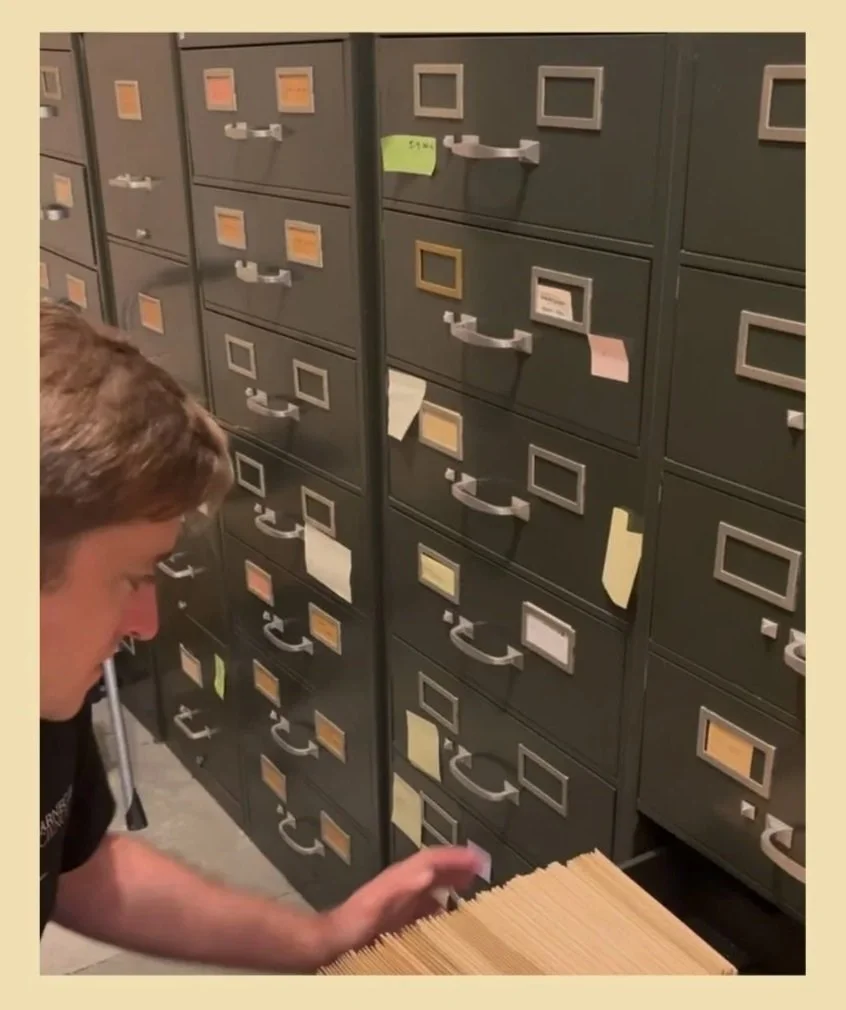
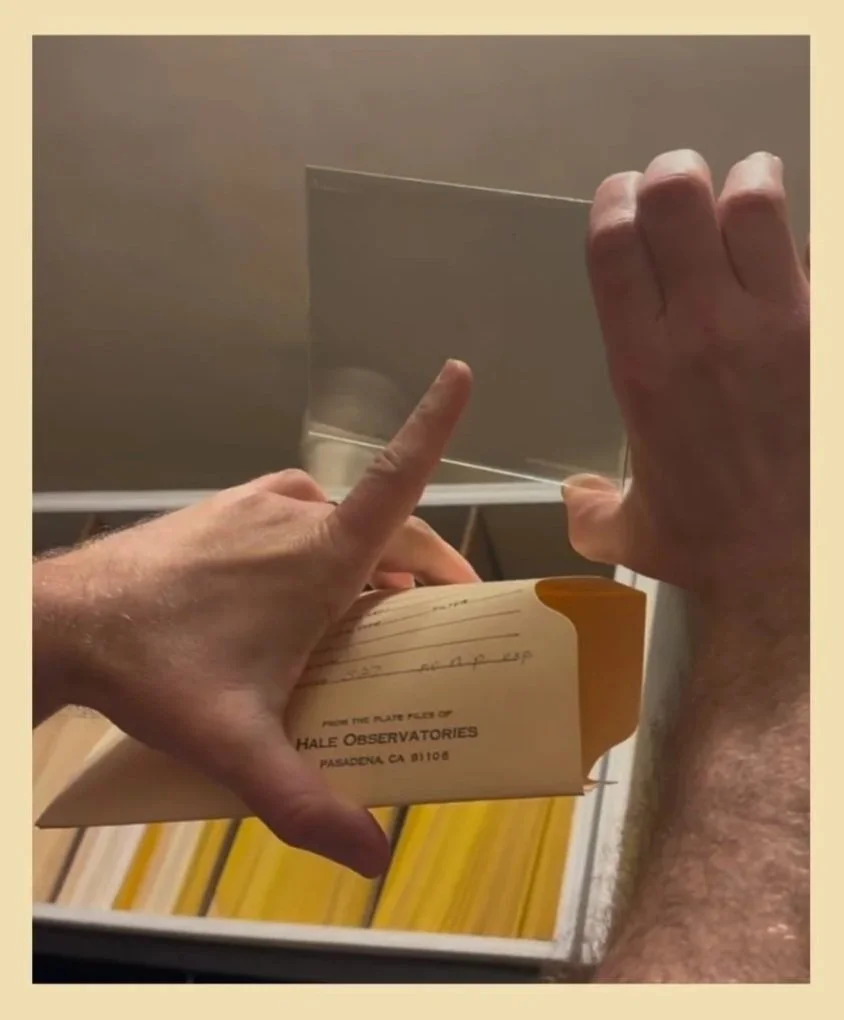
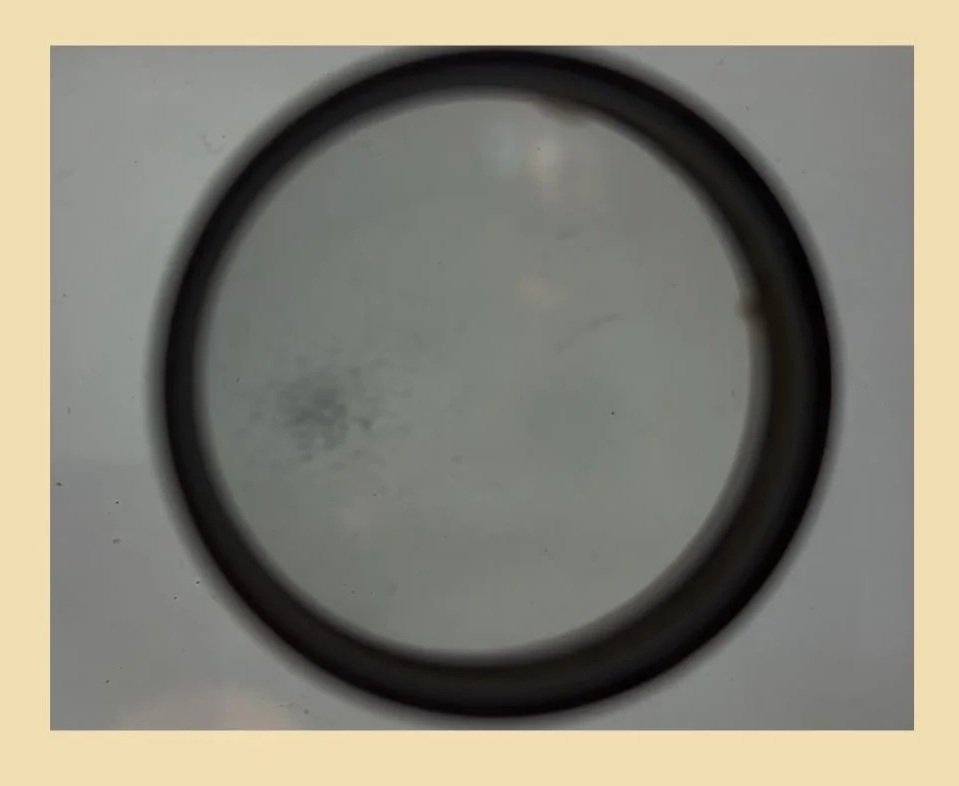
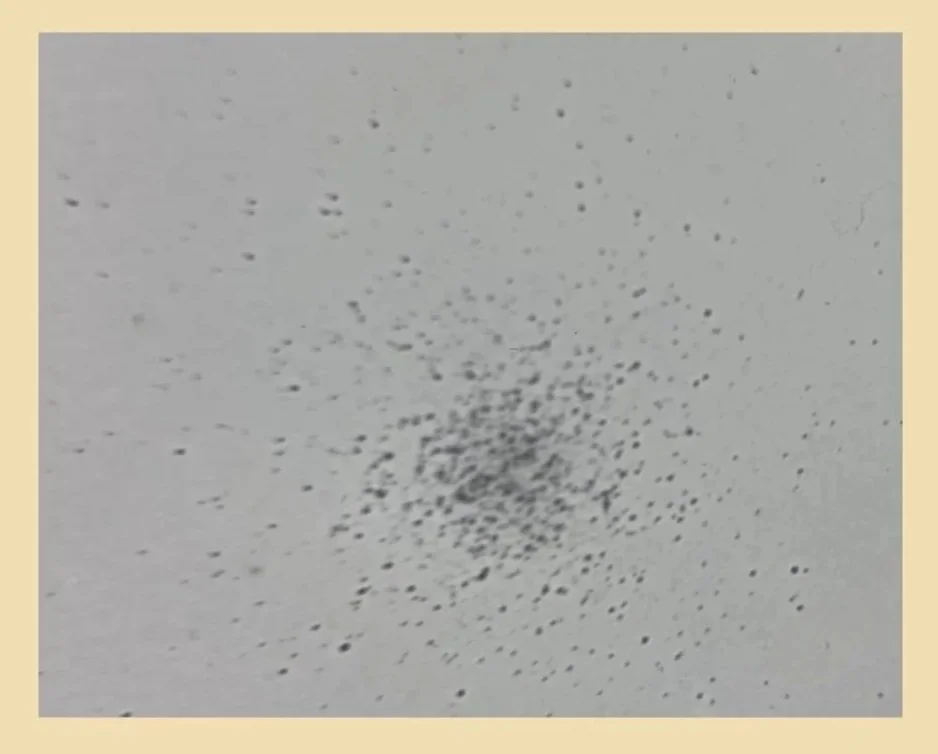
Step B: Search in the vault for the plate by its number in the table. Step C: Rich finds it where it should be & opens sleeve to view the plate. Step D: Plate on lightbox seen through magnifier. Step E: Close-up of plate on lightbox. These specks include the 1,300 stars in M 13 Shapley analysed in 1915 by the best telescope in the world. Except the photos are only by me on my wobbly iPhone. This was an impromptu test!
Why do the original plates matter? Our investigation showed that some important Shapley plates are in the Mount Wilson collection. Showing some would tell his steps and missteps in measuring globular cluster distances and the shape of the galaxy. They offer a chance to experience how astronomy was done at the time.
As well these early plates may provide new data when studied with today’s technology. Dr. Rich says, “We have definitely had requests from scientists for both spectra and images to be scanned for modern scientific research. We digitize on request.”
The center of globular cluster Messier 13 in Hercules, captured by an amateur in 2025 (cropped). More at https://en.wikipedia.org/wiki/Messier_13.
Data from Shapley’s M13 paper is still used today in the that shows RR Lyrae evolve over very long period variable stars. Horace Smith of Michigan State with Polish colleagues have found long-term variations in RR Lyrae by using data collected by Shapley and other astronomers at the time. 9/
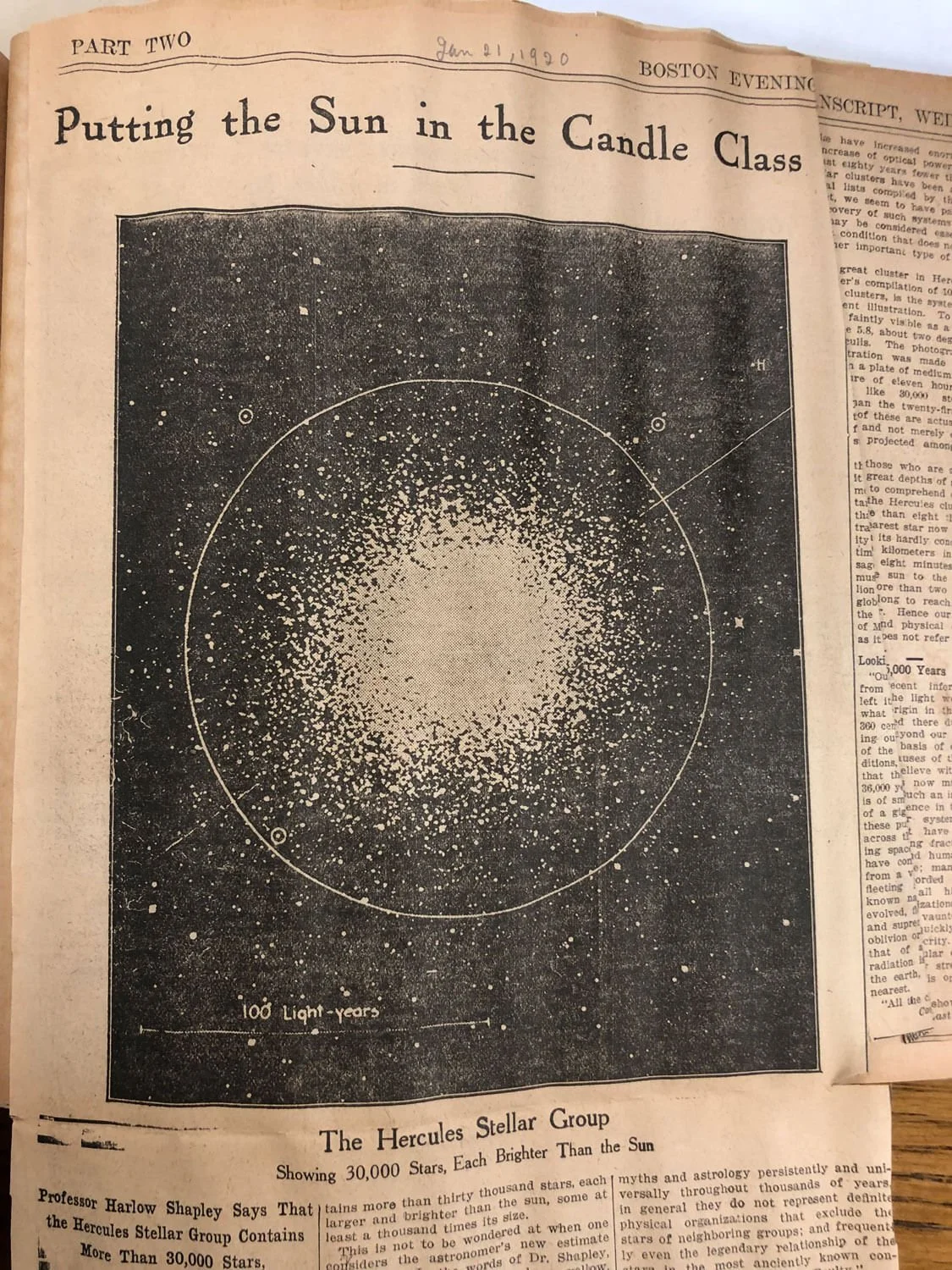
Photograph of Hercules globular cluster in article on Shapley’s pathbreaking work, from personal scrapbook. Harvard University Archives.
Shapley showed photographs of the great Hercules cluster in his talks and sent the image to newspapers. At left is a Boston Evening Transcript article about his work that ran on January 21, 1920. I found it in a personal scrapbook he and Martha kept of news clippings about his work at Harvard University Archives.
Still which are Shapley’s plates? Usually the astronomer who made a plate wrote their name on it’s paper sleeve. But I was told Shapley rarely wrote his name or initials on them. Maybe he meant them for the general collection.
But on one mysterious envelope with a plate for the M 22 cluster, I recognized the strange squiggles. They are Shapley’s Gregg shorthand! So we know that one is his!
Stop 3: Stargazing on the Mountain
Astronomy in California requires mountains! Saturday I journeyed up the steep, zig-zag drive up to the warm, sunny heights of Mount Wilson Observatory campus.
There at 5710 feet you see Pasadena and the ocean far below. Dr. Rich drove me up easily; he often teaches astronomical adventures to youngsters at the big machines there.
Mount Wilson Observatory campus. Credit: MWO.
I joined an afternoon tour led by Patricia Hill, a long-term Mt Wilson volunteer. Hill is personally renovating the disused Snow Solar Telescope, which George Ellery Hale brought to this peak in 1904 to launch the campus Dissatisfied with the Snow, he conceived the 60- foot high white coelostat which opened in 1908. On this new the passionate scientist Hale discovered the Sun’s magnetic fields. Thus he opened the field of solar astrophysics and stellar magnetism.
The 150-foot high solar telescope tower opened in 1912. This heliostat has been used to record sunspot activity on sunny days continuously since January 4, 1917. Hill led us into the small laboratory at the tower’s base. The image of the Sun appears in real time on a wide bright disk. You can see the dark irregular forms of sunspots and wispy “floccule.” On a paper set over the screen, volunteer Steve Padilla traces the dark shapes and arrows of magnetic field. The Sunspot Records from this observatory began in 1917.
At the base of the 150 foot solar tower volunteer Steve Padilla shows a visitor his tracings of visible activity on the Sun. This is Padilla’s fiftieth year maintaining the "Sunspot Record.”
Our group walked out over on to the giant white dome of the 100-inch telescope. There I met the stately bearded figure of the Director of Science Tim Thompson. He is distiguished by having 3,900 Facebook followers! https://facebook.com/tim.thompson.7547
Volunteer Patricia Hill and Deborah Shapley by the 60-inch telescope with a studio portrait of Shapley in 1927. He used this instrument to map all 69 known globular clusters which revealed the true shape and large size of our galaxy. Photo: D Shapley
Ms. Hill led our group next to the 60-inch telescope, where she explained his work. When it was my turn, I added that my grandmother Martha Betz Shapley helped with some of his great papers and published her own research though women were not allowed to observe.
That afternoon more ticket-holders arrived strolled in the clear, pine scented air. Their tickets included the 5 pm lecture by Caltech’s Gabriele Vajentes on LIGO. Afterward people went outside for snacks from the food truck and sightseeing. ann rpt The trustees had a few of us for supper on the refurbished terrace of The Monastery where the astronomers lived. My guest was Jennifer Lynn Bartlett of the new Science Explorer Digital Library SciX, formerly NASA.ads. She is a leader in indexing scientific literature to make it as widely available as possible. Thanks to Bartlett (@astrojen) Harlow Shapley Project content will be posted in Zenodo, the worldwide literature base.
Dinner at The Monastery: MWO Board Chair Sam Hale with Jennifer Lynn Bartlett, Deborah Shapley and Gabriele Vajente. Photo: Dan Kohne
As darkness fell, people formed lines to peer through the eyepiece of the 100-inch telescope to see real stars. The 100-inch Hooker telescope is the largest white dome on the campus. It opened in 1919. On it Edwin Hubble searched the ‘nebulae’ for signs they were distant beyond even Shapley’s Big Galaxy. Hubble’s plate of part of M-31, the Andromeda galaxy, showed Cepheid variables in its blurry haze. Hubble computed it was 1.5 million light-years away – a distance that Hubble announced January 1, 1925, after checking his distance results with Shapley. Thus on the world-beating telescope Hale opened in 1919, Hubble and MWO astronomers found the universe!
When my turn came to peer through the eyepiece, I saw the beautiful globular cluster M3 (NGC 7252) another in Shapley’s 69-cluster skeleton.
Outside on the grass another line took turns through a smaller telescope. When I squinted through the eyepiece, there was M-13, Shapley’s great friend! It was not specks on a dainty plate nor a glamorous modern photo. The real Hercules cluster glinted at me in a quasi-close meeting 25,000 light-years distant. I was so surprised that I forgot to say Hi!
Stop 3+: Dives in the Archives
Lastly I thank AIP for supporting my three days at Huntington Library. There I focused on Shapley’s formative relationships. His mentor at the U of Missouri had been Frederick Seares, who joined the Mount Wilson staff in 1909. Seares recommended that Hale hire the promising young Shapley. Seares’ own research informed Shapley’s work. Also Seares edited all the MWO astronomers’ papers including Shapley’s huge outflow from 1914-1921.
I also sought more on Hale’s influence on young Shapley. Most accounts have Hale, the MWO director, offstage in Washington after Shapley arrived in April 1914. But in Hale’s papers I found clues of his influence on his “star”protégé.
One surprise popped up in a letter Shapley wrote Hale October 29, 1918. 11/ That year Shapley had rolled out Papers VI and VII on the arrangement of the sidereal universe. As an aside to other matters, Shapley wrote:
“I recently brought a few of your evolution books from your house to your office. They are extremely interesting – much more than astronomy.” Shapley pursued his interest in evolution over his entire career.
Shapley was fascinated by the evolution of Earth, its plants, animals, insects and man. (From the 1950s he would promote the link between biological evolution and the evolution of the universe. That’s another post.)
So. Did George Ellery Hale, the genius scientist, inventor and organizer spark young Shapley’s interest in evolution?
Surprises are one reason research trips are fun.



Notes
1/
2/
3/
4/
5/
6/
7/
8/
9/
10/
11/